Introduction
With increasing globalization, India has emerged as a preferred destination for foreign investments. Setting up a company in India ensures regulatory compliance, improves credibility, and provides access to funding.
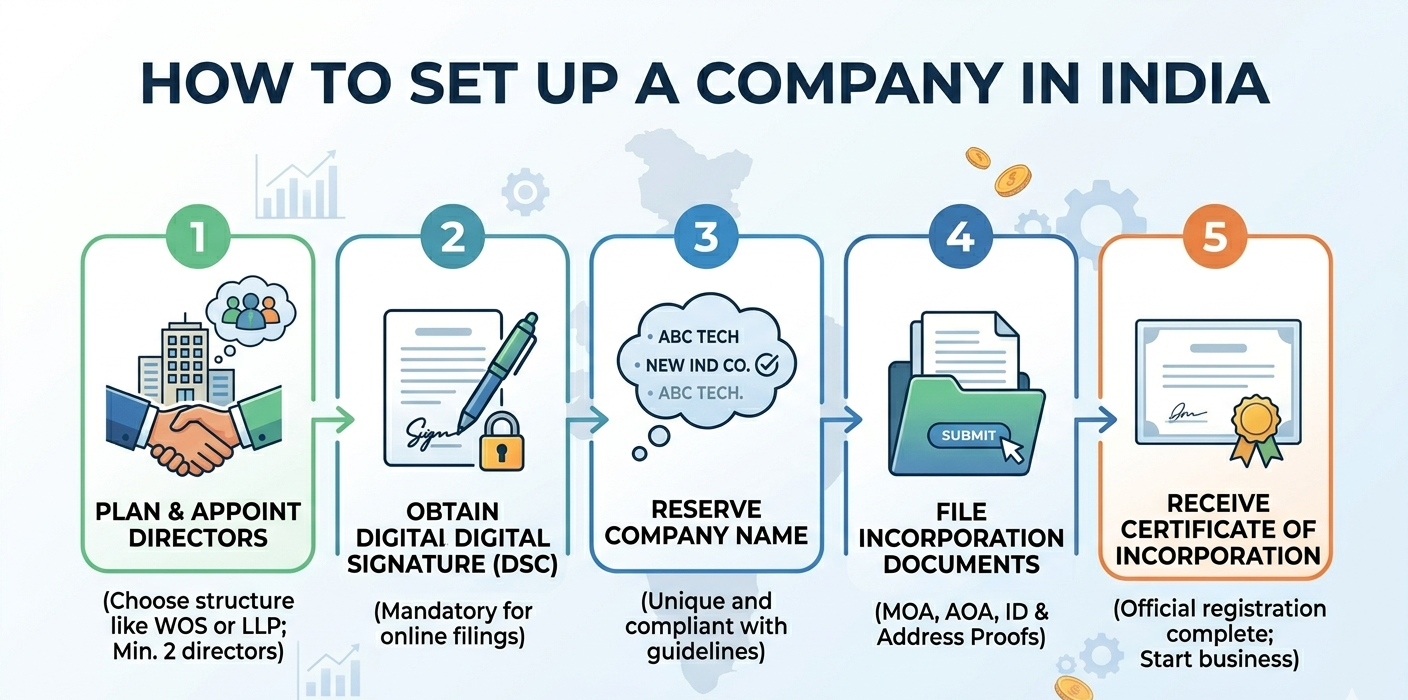
How to Set Up a Company in India
| Step | Action | Details |
|---|---|---|
| 1 | Plan & appoint directors | Choose WOS or LLP; min. 2 directors |
| 2 | Obtain Digital Signature (DSC) | Mandatory for online filings |
| 3 | Reserve company name | Unique and compliant with guidelines |
| 4 | File incorporation documents | MOA, AOA, ID & address proofs |
| 5 | Receive Certificate of Incorporation | Official registration complete |
Operating as an Indian Company
- Wholly Owned Subsidiary — 100% foreign ownership; treated as Indian resident company
- Joint Venture with an Indian Partner — equity collaboration leveraging local expertise
- Limited Liability Partnership (LLP) — limited liability with operational flexibility
Operating as a Foreign Company in India
- Liaison Office — representation and market research (RBI approval required)
- Branch Office — commercial operations subject to RBI approval
- Project Office — for executing specific projects in India
Key Requirements
- FDI Approval — automatic or government route
- Permitted Activities aligned with MOA
- Funding Options — equity, foreign investment or borrowings
- Compliance under Companies Act and FEMA
Advantages
- Separate legal entity
- Perpetual succession
- Limited liability
- Ease of ownership transfer
- Transparency and credibility
Process and Requirements
Directors and Shareholders
A private limited company requires a minimum of two directors and two shareholders. At least one director must be an Indian resident.
Digital Signature Certificate (DSC)
Mandatory for filing incorporation documents online. Foreign nationals require notarized and apostilled documents.
Company Name Approval
The proposed name must be unique, not conflict with existing companies, and end with "Private Limited" for private companies.
Filing Incorporation Documents
- Details of share capital and shareholders
- Registered office proof
- Identity and address proof of directors
- MOA & AOA
- Declarations and consent forms
Conclusion
Setting up a company in India offers significant opportunities for foreign investors, supported by a robust legal framework and growing economy. A well-planned approach combined with professional guidance ensures smooth company registration and long-term business success.