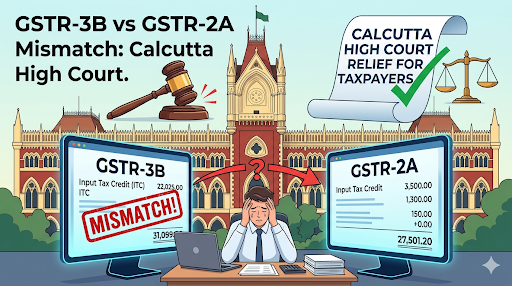
Mismatch between GSTR-3B and GSTR-2A remains one of the most frequently disputed issues under the GST regime in India. Tax authorities have often denied Input Tax Credit (ITC) to taxpayers due to differences between the returns. This exposes businesses to significant financial risks.
In a landmark ruling, the Calcutta High Court has brought much-needed clarity to the situation. It answers whether a buyer can be denied ITC because of a supplier's fault.
Understanding Input Tax Credit (ITC) Under GST
To validly claim ITC under Section 16 of the CGST Act, the following conditions must be satisfied:
- The recipient must have received the goods or services
- The recipient must possess a valid tax invoice or debit note issued by a registered supplier
- The tax charged on the supply must have been paid to the Government
- The supplier must have furnished the relevant GST returns
GSTR-3B vs GSTR-2A: Source of Mismatch
- GSTR-3B: a self-declared summary return filed by the taxpayer
- GSTR-2A: an auto-generated statement reflecting inward supplies based on supplier filings in GSTR-1
Legal Framework: Rule 36(4)
- Up to 20% of eligible credit (initial phase)
- Reduced to 10% from January 1, 2020
- Further reduced to 5% from January 1, 2021
- From January 1, 2022 (Section 16(2)(aa)) ITC only to extent reflected in GSTR-2B
Case Background: Suncraft Energy Private Limited
During FY 2017-18, the company procured goods and services from vendors and paid GST to the suppliers. However, certain invoices were not reflected in GSTR-2A. The GST department issued a show-cause notice demanding reversal of excess ITC and additional demand for tax, interest, and penalties.
Core Legal Issue
Can a bona fide purchaser be denied Input Tax Credit due to the supplier's failure to deposit GST with the Government?
Judicial Precedents Relied Upon
- Union of India v. Bharti Airtel Ltd (2022) – Supreme Court held GSTR-2A is a facilitative tool for self-assessment
- Arise India Ltd. v. Commissioner of Trade and Taxes – Delhi High Court held bona fide purchasers should not be penalized for seller's default
Final Ruling of the Court
- The demand order issued by the GST department was set aside
- Authorities must first proceed against the supplier
- ITC cannot be denied solely due to GSTR-2A mismatch
Exceptions Where ITC May Still Be Denied
- Supplier is non-existent or missing
- Supplier has ceased business operations
- Supplier lacks sufficient assets
- Evidence of fraud or collusion between parties exists
Practical Compliance Measures
- Record all purchase invoices promptly in books
- Verify supplier GST compliance regularly
- Match invoices with GSTR-2A and GSTR-2B
- Follow up with vendors for timely filing of returns
- Ensure payment within 180 days
Conclusion
The Calcutta High Court ruling reinforces the principle that bona fide purchasers should not be penalized for supplier defaults without proper investigation. A proactive approach to vendor management and documentation will be key to safeguarding ITC claims in the future.